I laughed out loud at the the photo of a "cheese platter" the Taipei Kid found in his hotel room. Maybe you'd have to know Taiwan to fully get the humor of it, but in a way, it is sort of charming.
Tangentially related--I am working on a translation of an article about the "Taike 台客" phenomenon in Taiwan. The characters are the first character of "Taiwan" and one meaning "guest" or "customer" (or, sometimes--like here--just something like "guy"). The word was originally derogatory and was used by the so-called "mainlanders" who came over with the KMT to refer to the locals. You could say meant something like "Taiwanese hick" or something like that. The "Tai" is also used as an adjective--"That's so Tai," meaning tacky or trashy.
Recently, the term has been used a lot on TV, with varety shows featuring segments like "My Taike Boyfriend." People are coming around and embracing the term, using it to imply a kind of homegrown culture. It's loud shirts, flip-flops, fast scooters, Long Life brand cigarettes, and betel nut.
There are plenty of words in English that have been reclaimed, probably most notably "queer." There's also that "N-word," the rehabilitation of which is a little more problematic. I never really thought about it, but this goes on in other languages as well. Maybe the Japanese word "otaku"?
Update: For a nice article written by a southern Taiwanese in Taipei, see Feiren's fine translation at Rank. It's not exactly on the subject of Taike, but it's close, and the article I have been working on talks about this "Taipei et les Provinces" attitude as well. Thanks, Feiren, for making it available in English!
Wednesday, May 03, 2006


Monday, April 24, 2006
Banning Keigo
The Los Angeles Times features an interesting obituary for a man named Otis Cary who was a Navy translator during World War II. He served with Donald Keene. Cary supposedly could get POWs to "convert" and assist the occupation:
Cary's deep understanding of the Japanese enabled him to help the POWs overcome their shame at having been captured and their fears of returning home in disgrace. He encouraged them to see themselves as patriots, who had given their all to their country and who now had a duty to support its reconstruction.After the war, he worked for Doshisha University in Kyoto, helping to start a graduate program in American Studies and running a dormitory called Amherst House:
For 32 years, he was director of Amherst House, a dormitory where he encouraged Japanese students to dispense with customs that he considered obstacles to modernization.I wonder what sort of psychological effect it would have for Japanese to have to use plain speech with everyone in their dorm. Would they really start to see themselves as equals?
One of his targets was honorific speech, which mandates different degrees of politeness depending on a person's social rank. To put students on an equal footing, Cary just gave them nicknames.
Sunday, April 23, 2006
Bilingual Counseling
Back when I used to teach English in Taiwan, some fellow teachers and I would jokingly refer to some of our private classes as "therapy cases"--some people would just take English classes to have someone to talk to and take advantage of the dissociative effects of speaking a foreign language.
The Asahi Shimbun has a story on an actual therapist, a gaijin names Andrew Grimes, who offers counseling in English and Japanese.
The Asahi Shimbun has a story on an actual therapist, a gaijin names Andrew Grimes, who offers counseling in English and Japanese.
Grimes is intrigued by language. For some of his Japanese patients, English offers something of a reprieve, an easier way of talking about their problems. "There is a belief in some people's hearts and minds that perhaps speaking in English, one is able to express one's individual, personal feelings more freely," he says, offering examples of patients who have endured abuse in one language and feel more at ease talking about it in another.The article says he also counsels international couples. I can see how it would be beneficial to have someone who'd get the nuances of both languages.
For the Japanophile Who Has Everything....
The perfect gift, bamboo headphones: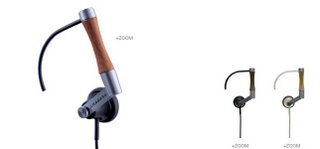
They are beautiful, and each pair is unique.
But buyer beware: you cannot crack a safe while using them, they cannot be used to amplify internal voices, and they may prevent ninja from climbing walls. Don't say they never told you so--it's all right there on the vendor's page.
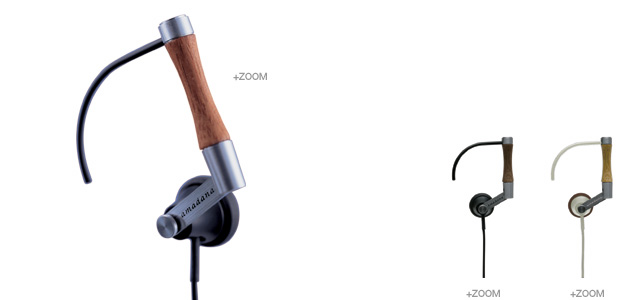
They are beautiful, and each pair is unique.
But buyer beware: you cannot crack a safe while using them, they cannot be used to amplify internal voices, and they may prevent ninja from climbing walls. Don't say they never told you so--it's all right there on the vendor's page.
Wednesday, April 05, 2006
More Proof...
If you need any convincing of the ever-growing culture gap between Taiwan and China, you need look no further than this New York Times headline:
Oddly enough, the NYT version of the article doesn't name the "opposition lawmaker," but it is in the International Herald Times version: "Chin Ching-sheng, the secretary general of the People First Party."
China Tries Wooing Taiwan by Honoring First Emperor
I wish I could say I made that up, but it's true.The ceremony was a lavish display calculated to woo the Taiwanese public and instill national pride across China. Leaders from the National People's Congress, China's rubber-stamp Parliament, and top executives from state-controlled Chinese industries, joined a senior Taiwanese opposition lawmaker and 700 Taiwanese businesspeople in paying their respects to Huang Di, China's semi-mythical first emperor, who is said to have lived 5,000 years ago.
...The event was the latest and most unusual in a series of Chinese initiatives to lessen popular resistance in Taiwan toward an eventual political unification with the mainland.
What on earth are they thinking?!? That's not going to "win over" anyone who wasn't a Great China-ist to begin with. This is what happens when you start believing your own propaganda.
Oddly enough, the NYT version of the article doesn't name the "opposition lawmaker," but it is in the International Herald Times version: "Chin Ching-sheng, the secretary general of the People First Party."
Monday, April 03, 2006
Gold Frappe Grande?
I thought it was funny that the name of band Goldfrapp (which comes from the singer's surname) was translated into Chinese as if it were "gold frappe" ("frappe" as in the icy coffee drink), but apparently it isn't just the Taiwanese record company who got the name wrong. Recently quite a few people have arrived at this page after searching Google for "Gold Frappe," and these searches are not originating in Taiwan.
Goldfrapp's latest CD is Supernature .
.
(which comes from the singer's surname) was translated into Chinese as if it were "gold frappe" ("frappe" as in the icy coffee drink), but apparently it isn't just the Taiwanese record company who got the name wrong. Recently quite a few people have arrived at this page after searching Google for "Gold Frappe," and these searches are not originating in Taiwan.Goldfrapp's latest CD is Supernature
.
Friday, March 31, 2006
Sci-fi Reflections
Though I have read the occasional Philip K. Dick novel, I never really got into sci-fi (or manga or anime). However, I did find this essay by a Japanese sci-fi writer named Takashi Ogawa interesting. He starts by saying how Americans always tell him how "cool" Japan is:
Now he says that neophilia is Japanese tradition, and what's more, gives a defense of it.
Of course it feels good to have people praise your own country, but I would always stop and wonder what exactly they liked. Sometimes they would get more specific, praising our anime, technological gadgetry, or Haruki Murakami. On the one hand I'd agree, but then again their rock/punk/rap music, PCs, or William Gibson/Raymond Carver/Tom Robbins all seemed even cooler to me.He says he originally held a dismissive attitude toward some of the same Japanese things his American friends praised. The artists they liked, he thought, were just "neophiles" ungrounded in tradition.
Now he says that neophilia is Japanese tradition, and what's more, gives a defense of it.
The very first Japanese novel—The Tale of the Bamboo Cutter—was a fairly tale, ending with a pun. We have always favored childish things like wordplay and spectacle over the subtler arts of the aristocratic "high culture" of the ruling class. We like to laugh away the gravity and smugness of the metaphysical musings of the elite. But it never amounts to real criticism, or to a genuine counterculture. People simply invent funny words or gestures and enjoy their silliness, just like kids. And by going back to their childhood this way, they can start their lives anew. Words and actions lose their serious, heavy meanings and become plastic and flexible. The childish element in our culture allows us to see things from a new, irreverent perspective. So it was all right to regard manga, anime, and all those silly things that otaku neophiles appreciate as quintessential arts of our pop culture.Plastic, flexible, irreverent--sounds pretty good to me.
Thursday, March 30, 2006
Otaku Incentives
I'm not a big fan of manga or anime (the closest I get is Miyazaki Hayao), but more and more non-Japanese people are, and some of them have been inspired to learn the Japanese language. It was nice to read in this Japan Times article that a lot of students who might not be interested in school otherwise are getting into learning Japanese because of the pop stuff:
I didn't get the chance to learn a foreign language until I was in junior high. Japanese wasn't offered, though I would have loved to take it. I took Spanish, and all the pop culture we got was Spanish versions of songs by Sting and Abba. When I started Chinese in college, no pop culture was employed at all in the classroom, but my abilities took off when I discovered Faye Wong and Cui Jian on my own. I don't know if it qualifies as manga or even pop culture, but Tsai Chih-chung's comic-book versions of the Chinese classics were also a big help in learning Chinese for me.
There are several factors behind the popularity of Japanese at Hendon. One is the sheer excitement at studying a language so different in sound and appearance to English. As the subject head, Helen Langsam, explains: "Japanese seems to appeal to students who maybe lose their concentration and focus in school. These sorts of children tend to persevere with Japanese and continue to learn and do well in it and I think this is because it's seen as a cool language to learn."It's great to see that some students start to do better in school when offered something they are interested in.
I didn't get the chance to learn a foreign language until I was in junior high. Japanese wasn't offered, though I would have loved to take it. I took Spanish, and all the pop culture we got was Spanish versions of songs by Sting and Abba. When I started Chinese in college, no pop culture was employed at all in the classroom, but my abilities took off when I discovered Faye Wong and Cui Jian on my own. I don't know if it qualifies as manga or even pop culture, but Tsai Chih-chung's comic-book versions of the Chinese classics were also a big help in learning Chinese for me.
Subscribe to:
Posts (Atom)
